
Latin I (Period 1) Assignments

Upcoming Assignments RSS Feed

No upcoming assignments.

Past Assignments

Due:

Assignment

Quiz on the verb chart on page 271.  Know all 4 conjugations in all 6 tenses.  Fill out the practice quiz.  You can do it!!!

Due:

Assignment

Use the worksheet we did in class to study for a quiz tomorrow.  Make sure you know how to construct the perfect, future perfect, and pluperfect tenses, as well as the imperfect, future, and present tenses.

Due:

Assignment

Quiz on the reflexive pronouns:
 
The forms for the reflexive pronouns are as follows.  There is no form for the nominative and vocative.
 
                  (myself)       (ourselves)        (yourself)         (yourselves)
Nominative  ---------------------------------------------------------------------------------------
Genitive      mei                nostri               tui                    vestri
Dative         mihi               nobis               tibi                    vobis
Accusative  me                 nos                  te                       vos
Ablative      me                 nobis                te                     vobis
Vocative     ---------------------------------------------------------------------------------------
 
For third person singular and plural, the forms are the same.  You tell them apart by context, looking back to the subject.
 
                      (himself/herself/itself)                  (themselves)
Nominative -------------------------------------------------------------------------------------------
Genitive                  sui                                          sui
Dative                     sibi                                         sibi
Accusative              se                                            se
Ablative                   se                                            se
Vocative --------------------------------------------------------------------------------------------------
 
Examples:
 
They love themselves.    Amant se.
He loves himself.            Amat se.
I love myself.                  Amo me.
She loves herself.          Ea amat se.    or just    Amat se.
You (pl.) give gifts to yourselves.    Datis dona vobis.
You (sg) know the love of yourself (sg).   Scis amorem tui.
 
Do these sentences by yourself for the quiz on Tuesday:
 

He ate himself.

She was killing herself.                 

They were praising themselves.

He gave a gift to himself.                             

I love myself.                                    

You (sg) love yourself.

Due:

Assignment

Quiz on worksheet 35.
 

Translate this passage on the Eucharist by St. Thomas Aquinas:

O Salutaris Hostia ______________________________________

Quae caeli pandis ostium! ______________________________________

Bella premunt hostilia.______________________________________

Da robur; fer auxilium!______________________________________

Vocab:

salutaris, salutare [saving]

hostia, ae [victim]

qui quae quod [who, which] *the antecedent of quae is hostia.  Quae here is NOMINATIVE

caelum, i [heaven]

pando pandere pandi passus [open]

ostium, i [door]

bellum, i [war]

premo premere pressi pressus [overwhelm, press hard, oppress]

hostilis, e [hostile]

do dare dedi datum [give]

robur, roboris (neuter) [strength]

fero, ferre, tuli, latum [bring]

auxilium, i [help]


Give the tenses for amare, timere, and regere only for 1st person.  Here are the answers:

amo amabam amabo amavi amavero amaveram

timeo timebam timebo timui timuero timueram

rego regebam regam rexi rexero rexeram


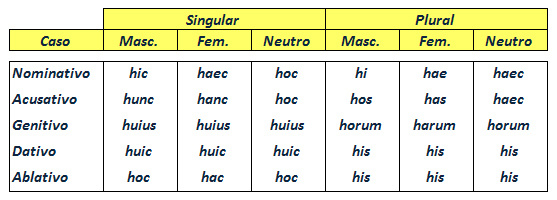
Here is the chart for he she it.  The chart after it is for the plurals: they (masculine), they (feminine), those (neuter)

Don't worry about the chart for the reflexive pronoun.  We will do that tomorrow.

Due:

Assignment

Don't worry about finishing the translation from the worksheet.  You do not need to turn it in.  Focus on the following quiz.  I don't want to give you too much.
 
Memorize these charts for a quiz:
 
Ille, illa, illud means "that."  It is a demonstrative adjective.  For example, "That man is good."  It becomes a demonstrative pronoun when used alone.  For example, "That is yummy."  Here is the chart:
 
ille      illa       illud                illi           illae      illa
illius ------------------>                illorum    illarum   illorum
illi ---------------------->               illis ------------------------>
illum   illam    illud                illos        illas       illa
illo      illa       illo                 illis ------------------------>
ille      illa      illud                 illi           illae       illa
 
Memorize the charts for ego (I), tu (you singular), vos (you plural), and nos (we).  Here they are:
 
ego
mei
mihi
me
me
ego
 
tu
tui
tibi
te
te
tu
 
vos
vestri
vobis
vos
vobis
vos
 
nos
nostri
nobis
nos
nobis
nos
 
Here are your 5 sentences:
 
1. That woman to whom we gave the dragon was big, man!
do dare dedi datum
draco draconis
 
 
2. That boy ate that animal for us.
manduco (1)
*dative case is to or FOR
 
3. This man whose arms are long loves you.
brachium, i               longus, a, um
 
 
4. These monsters gave those gifts to you (plural).
monstrum, i         do, dare, dedi, datum                   donum, i
 
 
5. The eyes of these women who ate too much are looking at me!
oculus, i              manduco (1)            nimis (too much)     specto (1) (look at)]
*Make sure that you put "of these women" in the genitive.  Then the "who" must match women in number and gender BUT NOT CASE.  The case of "who" is determined by its function in the relative clause.

Due:

Assignment

No homework!  Just work on your corrections.

Due:

Assignment

Quiz on worksheet 33.  It is attached.
 
singular:
Qui        quae     quod
cuius      cuius     cuius
cui          cui          cui
quem       quam    quod
quo            qua      quo
qui          quae      quod
 
plural:
qui         quae      quae
quorum quarum quorum
quibus quibus quibus
quos       quas     quae
quibus quibus quibus
qui          quae quae
 
The translations of qui quae quod are:
nominative: who, which
genitive: of whom, whose
dative: to whom
accusative: whom
ablative: by/with/from whom
vocative: who
 
Answers to questions:
 
A relative pronoun is a noun with an antecedent which begins a relative clause.
 
The man who sings laughs.
 
The man whom God loves loves God.
 
The charts for Hic haec hoc are here.
 
 
A demonstrative pronoun is a noun with an antecedent that points it out.  Hic haec Hoc used without a noun, becomes a demonstrative noun.  Without a noun, it is a demonstrative adjective which just means "this, these."
 
Hic vir est bonus = this man is good
Haec est bona = this (woman) is good

Due:

Assignment

Quiz on the worksheet we did today.  Attached is the worksheet.  If you did not fill it out in class, ask a classmate.  You are responsible for getting the answers yourself.

Due:

Assignment

Attached is the quiz.
 
For each stanza of the "Veni, Sancte Spiritus," you will first give the translation.  Then, you will summarize the meaning of the stanza and write it out - a quick one sentence summary.  Then you will identity the beauty of the stanza, giving a reason for word order - sandwiches, parallel structures, placing a word first for emphasis, and/or chiasm.
 
Happy Pentecost!

Due:

Assignment

Quiz on the verses of the Bible that we translated today.
 

From Psalm 26:

1. Quoniam misericordia tua ante oculos meos est,
et complacui in veritate tua.

quoniam [because, since]

misericordia, ae (f) [mercy]

tuus, a, um [your]

ante + accusative [before]

oculus, i [eye]

meus, a, um [my]

complaceo, complacere, complacui, complacitus [to be contented]

 veritas, tatis [truth]

2. Non sedi cum concilio vanitatis, ...

 sedeo, ere, sedi, sessum [sit]

concilium, i [council]

vanitas, tatis [vanity]

3.  Odivi ecclesiam malignantium,

et cum impiis non sedebo.

 odio, odire, odivi, oditurm [hate]

ecclesia, ae [assembly]

malignans, malignantis [evil] *see the plural genitive substantive!

impius, a, um [impious] *see the substantive

4.  Lavabo inter innocentes manus meas,

et circumdabo altare tuum, Domine:

lavo, lavare, lavi, lautus [wash]

inter + accusative [among]

innocens, innocentis [innocent] *see the substantive!

manus, us (f) [hand]

circumdo, circumdare, circumdedi, circumdatus [surround]

5. Domine, dilexi decorem domus tuæ,

et locum habitationis gloriæ tuæ.

 diligo, diligere, dilexi, dilectum [love]

decor, decoris [beauty]

domus, us [house]

locus, i [place]

habitatio, onis [dwelling]

6.  Pes meus stetit in directo;

in ecclesiis benedicam te, Domine.

pes, pedis [foot]

sto, stare, steti, statum [stand]

directum, i [straight path]

benedico, benedicere, benedixi, benedictum [bless] *watch out for the TENSE

Due:

Assignment

Quiz on worksheet 31 (just what we did in class).  Attached is the worksheet for practice.

Due:

Assignment

Decline spiritus, us (m) [spirit]
 
Decline res,ei (f) [thing].
 
Decline dies, ei (f) [day]
 
Know the vocabulary on the Worksheet 30, identifying the gender of the words and their declension:
 
cornu, us
acus, us
anus, us
annus, i
fumus, i
genu, us
gelu, us
locus, i
socrus, us
pecu, us
domus, us
ludus, i
visus, us
 
facies, ei
oculus, i
spes, spei
murus, i
fides, ei
glacies, ei
effigies, ei
coquus, i
 
Give the principle parts for "praise" and define them in English:
 
Laudo            Laudare             Laudavi                  Laudatum
I praise           To praise            I have praised        Having been praised
                                                   I praised


Due:

Assignment

Quiz on the vocab from the worksheet.
 
Decline 4th declension nouns.  Memorize these charts:
 
Cursus, us (m) [running, track, course]
 
Nominative Cursus Cursus
Genitive Cursus Cursuum
Dative Cursui Cursibus
Accusative Cursum Cursus
Ablative Cursu Cursibus
Vocative Cursus Cursus
 
This chart works for both masculine and feminine 4th declension nouns.  The SIGN for 4th declension masculine or feminine nouns is "us, us" like in cursusus and manusus.
 
Manus, us (f) [hand]
 
Nominative Manus Manus
Genitive Manus Manuum
Dative Manui Manibus
Accusative Manum Manus
Ablative Manu Manibus
Vocative Manus Manus
 
The sign for a neuter 4th declension is just "u, us" as in cornuus (n) [horn].  The neuter chart is a little bit different:
 
Nominative Cornu Cornua
Genitive Cornus Cornuum
Dative Cornui Cornibus
Accusative Cornu Cornua
Ablative Cornu Cornibus
Vocative Cornu Cornua

Due:

Assignment

Instead of a worksheet and a quiz, I will just give you a quiz:
 
Conjugate volo, velle in the present, imperfect, and future
 
present indicative    active singular       active plural   
  voló volumus
  vís vultis
  vult volunt
 imperfect indicative 
  volébam volébámus
  volébás volébátis
  volebat volent
 future indicative
  volam volémus
  volés volétis
  volet volent
 
Conjugate nolo in the present, imperfect, and future
 
present indicative    active singular       active plural   
  nóló nólumus
  nón vís nón vultis
  nón vult nólunt
 imperfect indicative 
  nólébam nólébámus
  nólébás nólébátis
  nólébat nólébant
 future indicative
  nólam nólémus
  nólés nólétis
  nólet nólent

Due:

Assignment

Quiz on the following:
 
Decline celer, celeris, celere [quick, fast] (3rd declension adjective of 3 terminations).  Write this out by yourself.
 
________   _______  _______                 ________   _______  _______
________   _______  _______                 ________   _______  _______
________   _______  _______                 ________   _______  _______
________   _______  _______                 ________   _______  _______
________   _______  _______                 ________   _______  _______
________   _______  _______                 ________   _______  _______      
 
Decline tristis, triste [sad] (3rd declension adjective of 2 terminations).  Write it out by yourself.
 
________   _______  _______                 ________   _______  _______
________   _______  _______                 ________   _______  _______
________   _______  _______                 ________   _______  _______
________   _______  _______                 ________   _______  _______
________   _______  _______                 ________   _______  _______
________   _______  _______                 ________   _______  _______      
 
Decline this third declension adjective of 1 termination: potens, potentis [powerful]
 
potens       potens       potens                           potentes      potentes   potentia
potentis ----------------->                                    potentium ----------------->
potenti----------------->                                       potentibus    ----------------->
potentem potentem     potens                          potentes       potentes   potentia
potenti----------------->                                       potentibus  ----------------->
potens----------------->                                       potentes     potentes     potentia


Due:

Assignment

Finish the worksheet we did in class today.  Finish up the sentences at the end.  Then there will be a quiz on the whole worksheet.
 
Here is some help for the English sentences:
 
creo (1) [create]
habeo (2) [have]
 
Check your answers here:
 
Omnis vir bonus est.
Omnis femina pulchra est.
Deus omnia animalia creat.
Omnia bona sunt.
Omnes boves tardi sunt.
Omnes pueri duo brachia habent.

Due:

Assignment

No quiz.  You can just work on your corrections or make-up stuff.  God bless!

Due:

Assignment

Practice your charts from Declensions 1-3 and Conjugations 1-3.  For the quiz, I will ask you to decline
 
stella, ae (f) [star]
 
amicus, i (m) [friend]
 
donum, i (n) [gift]
 
lux, lucis (f) [light]
 
nox, noctis (f) [night]
 
mare, maris (n) [sea]
 
Then you will give the present, imperfect, and future for these verbs:
 
expecto (1) [expect, wait]
 
moneo (2) [advise]
 
rego, regere [rule]
 
capio, capere [capture]
 
scio, scire [know]
 
PRACTICE WRITING THESE OUT USING YOUR CHARTS, THE KEY TO LATIN HAPPINESS!!!

Due:

Assignment

Quiz on the passage from Chapter 14.  You can use the Internet to check your translation.  You will be quizzed on 5 random sentences from the passage tomorrow.

Due:

Assignment

Quiz on Worksheet 24.  You can print out the attachment and practice:
 
Conjugate sum, esse in the present
 
sum        sumus
es           estis
est          sunt
 
Conjugate sum, esse in the imperfect
 
eram      eramus
eras       eratis
erat        erant
 
Conjugate sum, esse in the future
 
ero        erimus
eris       eritis
erit        erunt
 
Conjugate possum, posse in the present
 
possum      possumus
potes          potestis
potest         possunt
 
Conjugate possum, posse in the imperfect
 
poteram     poteramus
poteras      poteratis
poterat       poterant
 
Conjugate possum, posse in the future
 
potero      poterimus
poteris     poteritis
poterit      poterunt
 
Decline auxilium, i
 
SingularPlural
Nominative Auxilium Auxilia
Genitive Auxilii Auxiliorum
Dative Auxilio Auxiliis
Accusative Auxilium Auxilia
Ablative Auxilio Auxiliis
Vocative Auxilium Auxilia
Decline periculum, i
 
SingularPlural
Nominative Periculum Pericula
Genitive Periculi Periculorum
Dative Periculo Periculis
Accusative Periculum Pericula
Ablative Periculo Periculis
Vocative Periculum Pericula
Decline iter, itineris
SingularPlural
Nominative Iter Itinera
Genitive Itineris Itinerum
Dative Itineri Itineribus
Accusative Iter Itinera
Ablative Itinere Itineribus
Vocative Iter
Itinera
Decline onus, oneris
Nom.
Gen.
Dat.
Acc.
Abl.
Singular
onus
oneris
onerī
onus
onere
Plural
onera
onerum
oneribus
onera
oneribus
 
Decline unus, a, um
(m)                  (f)                (n)
unus              una             unum
unius             unius          unius
uni                  uni                 uni
unum             unam          unum
uno                 una              uno
une              una              unum
 
SORRY!!!   I got the vocative wrong for the masculine!  It is UNE
 
Decline Duo, duae, duo
 
duo                   duae                  duo
duorum             duarum              duorum
duobus              duabus               duobus
duos                  duas                 duo
duobus              duabus              duobus
duo                    duae                  duo
 
Decline tres, tria
 
tres           tres             tria
trium        trium             trium
tribus         tribus        tribus
tres          tres             tria
tribus       tribus            tribus
tres           tres               tria
 
The adverbs are
periculose
clare
male
celeriter
acriter
pulchre
bene (IRREGULAR!!!!)
 
Conjugate diligo, dilgere in the present
 
diligo       diligimus
diligis       diligitis
diligit        diligunt
 
Conjugate diligo in the future
 
diligam     diligemus
diliges       diligetis
diliget        diligent
 
Conjugate gaudeo, ere in the present
 
gaudeo      gaudemus
gaudes      gaudetis
gaudet        gaudent
 
Conjugate gaudeo, ere in the future
 
gaudebo      gaudebimus
gaudebis    gaudebitis
gaudebit       gaudebunt
 
Translate these 3 sentences:
 
I will love God always. [amo, amare]
We will rejoice in Mary always.  [gaudeo, gaudere]
They never love school.   [use diligo, diligere; numquam; schola, ae]
 

Due:

Assignment

Happy Birthday Rome!  Thanks for such a great Roman Day!  You guys are the best.  No homework.  God bless!

Due:

Assignment

Thursday, there will be a vocab quiz on the back page of worksheet 23.  Fill it out.  You will turn in the whole worksheet on Thursday.  Find the translations in your book on pages 100-101.
 
Bring $5 to help pay for the expenses of Roman day.  If you want, bring olive oil, juice, or a toga!

Due:

Assignment

Translate the passage from pg. 97 in your book ON A SEPARATE PIECE OF PAPER.  YOU WILL TURN THIS IN ALONG WITH THE WORKSHEET WE DID TODAY.  There will be a quiz on random sentences tomorrow.  Here are some helpful hints for the translation.  These notes go in order of the translation:
 
"tribus diebus" is ablative of time = in three days
 
"volebat" is in the imperfect tense (an ongoing past action) = was wanting
 
"advenire" = to arrive ("venire" means to come and "ad" means to; thus, when you come to a place, you arrive)
 
"volebat" takes a complementary infinitive, here, advenire = was wanting to arrive
 
Syrum is the accusative for Syrus, i.  This is a proper name: Syrus.
 
iubebat is from iubeo, iubere [to command, order].  Again, this is in the imperfect tense.  "iubebat" = was commanding (a past, ongoing action: that's why there is an "ing" on "commanding")
 
"virga" is ablative of instrument = by a stick
 
Dum = while
 
ibant comes from eo, ire [to go], an irregular verb.  You can see the "bant" ending as imperfect.  "ibant" = they were going (see the "nt" in "ibant")
 
specto, are [to look] *see the imperfect ending! Here is the chart:
 
                                  spectabam           spectabamus
                                  spectabas            spectabatis
                                  spectabat             spectabant
 
qui = who
 
quae = which
 
per Viam Appiam = through the Appian Way (a very famous road in Rome)
 
erat = was *remember eram, eras, erat, eramus, eratis, erant
 
rusticus, a, um [rustic, rural, country]
 
non iam = not yet
 
quiesco, quiescere [to rest]
 
raeda, ae [carriage]
 
dormio, dormire [to sleep] *like dormitory
 
Marcus pede vexabat Corneliam quae dormire volebat.
      *pede is ablative of instrument = with [his] foot
      *quae = who (this refers to Cornelia)
      *volo, velle [to wish]
      *Marcus was bothering Cornelia with [his] foot, who was wanting to sleep.
 
raedario comes from raedarius, i (m) [carriage driver]
 
cum raedario Syro = with the carriage driver Syrus
 
sedeo, sedere [to sit]
 
specto (1) [to look]
 
vehiculum, i (n) [vehicle] *vehicula is neuter plural accusative = vehicles
 
subito (adverb) = immediately
 
auriga, ae [charioteer, chariot driver]
 
magno risu = ablative of instrument = with a big smile
 
Non est auriga, fatue! = It is not a charioteer, stupid!  * "stupid" is in the vocative case.  It can also be translated as a substantive "O stupid one" or "O stupid man" :)
 
tabellarius, i [letter carrier, post man]
 
qui = who
 
fert = carries *this comes from fero, ferre [to bear, carry], an irregular verb.  Here is the chart:
 
                              fero          ferimus
                              fers          feritis
                              fert           ferunt
 
civis, civis [citizen] *remember, this is a 3rd declension i stem!!!  That's why you see "civium."  This is a 3rd declension noun with the same number of syllables in the nominative and the genitive [parisyllabic].
 
praeclarus, a, um [distinguished] *epistulas civium praeclarorum = the letters of distinguished citizens
 
celeriter = quickly *this is the way to make adverbs for 3rd declension adjectives: add an "iter"
 
omnis, e [all]
 
quam celeriter = how quickly
 
virga *see the ablative of instrument!
 
Caveo, cavere [to beware]
 
teneo, tenere [to hold]
 
vito (1) [to avoid]
 
magno fragore = with a great crash *this is ablative of manner.  Usually, the ablative of manner uses "cum" but when the noun is accompanied with the adjective, you can cut the "cum out."  
 
descendo, descendere [to descend, fall]


Due:

Assignment

No quiz tomorrow.  God bless!  You guys are the best.

Due:

Assignment

Vocab test on these terms + 5 sentences:
 
Ubi                           where
unde                         from where
quocum                    with whom (singular)
quibuscum               with whom (plural)
quo instrumento       with/by what instrument
quomodo                  how
 
(the following words are all in the ablative: ablative of time):
 
septima hora           at the seventh hour
nocte                       at night
aestate                    in the summer
tribus diebus            in three days
brevi tempore          in a short time
 
next, practice the instrumental ablative by translating these sentences:
Servum baculo verberat.
Davus Getam tunica arripit.
 
5 sentences:
 
Verbum Domini verum est.
 
verbum, i (n) [word]
dominus, i (m) [Lord]
verus, a, um [true]
 
Amici divitum sunt multi.
amicus, i (m) [friend]
dives, divitis (m) [rich man]
multus, a, um [many]
 
Bona et mala a Deo sunt.
a + ablative [from]
*see the neuter plural ending for the substantives "bona" and "mala"
 
Omnia possibilia sunt apud Deum.
omnis, e [all] *remember that 3rd declension adjectives are i-stem in form.  This is a neuter plural nominative substantive
possibilis, e [possible] *this is a neuter plural nominative ending
apud + accusative [with]
 
Dominus Deus noster Deus unus est.
noster, nostra, nostrum [our]
unus, a, um [one]
 

Due:

Assignment

Translate the rest of the passage for chapter 12.  Quiz on that passage: random sentences.  + 3 unseen sentences.

Due:

Assignment

Quiz on Worksheet 21.  It is also attached as a file.
 

Conjugate disco, discere, didici, ------ in the present

______________________           ______________________

______________________           ______________________

______________________           ______________________

Conjugate disco in the future

______________________           ______________________

______________________           ______________________

______________________           ______________________


Conjugate facio, facere, feci, factum in the present

______________________           ______________________

______________________           ______________________

______________________           ______________________

Conjugate facio in the future

______________________           ______________________

______________________           ______________________

______________________           ______________________


Conjugate venio, venire, veni, ventum in the present

______________________           ______________________

______________________           ______________________

______________________           ______________________


Conjugate venio in the future

______________________           ______________________

______________________           ______________________

______________________           ______________________

Then a vocab test on the verbs of 3rd and 4th conjugation. In brackets are the English derivatives that can help you remember the words.  I will give you the Latin word and you will give me the English.

aperio, -ire, aperui, apertum [aperture, opening]

audio, -ire, -ivi, -itum [auditory, audio cassette]

scio, scire, scivi, scitum [science]

nescio, -ire, nescivi, nescitum

sentio, -ire, sensi, sensum

venio, -ire, veni, ventum

convenio, -ire, -veni, -ventum [convent, convene]

pervenio, -ire, -veni, -ventum 

bibo, -ere, bibi, bibitum, to drink [imbibe]                              

claudo, -ere, clausi, clausum, to close [cloister - an enclosed place for religious]    

cresco, -ere, crevi, cretum, to grow [crescendo]                 

desisto, -ere, -stiti, -stitum, to desist, stop          

dico, -ere, dixi, dictum, to say, speak                     

figo, -ere, fixi, fixum, to fasten, affix, transfix     

lego, -ere, legi, lectum, to read; gather; choose [legible]              

mitto, -ere, misi, missum, to send [missive, mission]

pono, -ere, posui, positum, to put, place [posit, deposit]

peto, -ere, petivi, petitum, to seek, ask [petition]

quaero, -ere, quaesivi, quaesitum, to seek, inquire, beg, ask [enquiry]

relinquo, -ere, reliqui, relictum, to leave behind [relic, reliquary, relinquish]

traho, -ere, traxi, tractum, to draw, drag [tractor]


Due:

Assignment

Study all the sentences we did in class.  There will be a quiz on these sentences.  I will choose random sentences to translate for the quiz.
 
Attached are the sentences which you can practice on.

Due:

Assignment

Quiz on the declensions of
 
via, ae
vir, viri
veritas, veritatis
urbs, urbis
 
+ 3 unseen sentences.
 
Then an oral quiz on simple Latin phrases.  Practice these sentences:
I love God.
I love the way of God.
I love the way of Mary.
We love...
I love women.
We love men.
We love the men of God.
We love the men and women of God.

Due:

Assignment

Finish translating the passage for chapter 11.  Write it on the worksheet that we did in class today and turn it in tomorrow.
 
Answer the questions about the story IN LATIN.  You will turn this in on a separate paper.

Due:

Assignment

Quiz on the worksheet we did today for tomorrow.
 
If you weren't at class, go to this website: 
 
 
to read up on 3rd declension i-stems and then do the attached worksheet.

Due:

Assignment

For the quiz, be able to conjugate
 
audio
venio
capio
and 
rego
 
Be able to identify which conjugations these are.
Be able to give the signs for conjugations 1-4 (including 3rd-I stem)
 
Don't worry about the sentences to do for homework.
There will be 9 unseen sentences on the quiz tomorrow.  :)  You'll be fine.  Don't worry.

Due:

Assignment

Sorry, I will not get your grades up tonight.  I will try to get them done before tomorrow's class.  Then you can come after school and get whatever you need by looking at powerschool.
 
Finish the last three sentences on the worksheet.
 
Add these notes.  Study the whole worksheet for a quiz tomorrow.
 
Davus est vilicus Cornelii et, si dominus abest, vilicus ipse villam domini curat.
 
NOTES
absum, abesse [to be absent]
 
ipse, ipsa, ipsum [himself, herself, itself] *an intensifying pronoun; vilicus ipse = the overseer himself
 
curo (1) [look after; care for]
 
Davus igitur omnes servos in aream quae est prope villam venire iubet.
 
NOTES
igitur (postpositive conjunction (this is a conjunction which is the 2nd word in the sentence) [therefore]
omnis, e [all]
servus, i [servant]
area, ae [open space, threshing floor] *a threshing floor is where you beat the grain
quae [which]
prope + acc [near]
venio, venire [come] *the INFINITIVE is used in the sentence...  to....
iubeo, iubere [order, command]
 
Brevi tempore area est plena servorum et ancillarum qui magnum clamorem faciunt.
 
brevis, breve (3rd declension adjective) [brief, short]
tempus, temporis (n) [time] *brevi tempore is all in the ABLATIVE OF TIME = in a short time
plenus, a, um [full]
qui [who]
magnus, a, um [big, great]
clamor, clamoris (m) [shout, cry]
facio, facere [make] *see the "unt" ending
 
2 extra sentences:
 
Give (pl) the names to me.
do, dare [give]
nomen, nominis (n)
ego, mei, mihi, me, me, ego [I, of me, to me, etc...]
 
The kings of the world desire money.
rex, regis (m) [king]
mundus, i (m) [world]
desidero (1) [desire]
pecunia, ae (f) [money]

Due:

Assignment

Finish the 2014 National Latin Exam.  Write out the translation of the Latin story on the back on a separate sheet of paper to turn in.
 
Some hints on the story:
 
line 1 "Diem natalem" comes from dies natalis [birthday]
line 4 "Tum" means "then"
line 6 "Ita" means "yes," and "vero" means "indeed"
line 6 respondeo, ere [respond]; sedeo, ere [sit]
line 7 monstro (1) [show]
line 9 domina, ae [lady]
line 9 sella, ae [seat, chair]
line 10 "dominae" is DATIVE!!!!!!!!!!!!!!
line 12 dico, dicere *here is the present conjugation:
 
dico             dicimus
dicis            dicitis
dicit             dicunt
 
line 13 For "porto" use the present progressive for the translation: am carrying
 
3 extra sentences:
1. Dicunt mihi.
 
dico, cere [say, speak] *use the best translation; *look at the chart above!!!
 
*remember that mihi is from ego:
 
N. ego
G. mei
D. mihi
Acc. me
Abl. me
V. ego
 
2. Dicitis dominae et domino.
domina, ae [lady]
dominus, i [lord]
 
3. Semper dico veritatem matri meae.
veritas, tatis [truth] *this is third declension feminine:
 
veritas             veritates
veritatis           veritatum
veritati             veritatibus
veritatem         veritates
veritate            veritatibus
veritas             veritates
 
mater, matris [mother] *third declension!!!!  Look at the chart of "veritas"!!!
meus, a, um [my] *notice that it matches "matri" in case, number, and gender

Due:

Assignment

Translate "A hunter catches Diana by surprise" from the National Latin Exam  2012.  Write it on a separate piece of paper.  Then answer questions 31-40.  You will turn the sheet in to me.  
 
The quiz will be on random sentences chosen from this story.

Due:

Assignment

Quiz on:
 
Present tense of sum, esse
 
sum       sumus
es          estis
est         sunt
 
 
Future tense of sum, esse
 
ero        erimus
eris       eritis
erit        erunt
 
 
Imperfect tense of sum esse (simple past)
 
eram    eramus
eras     eratis
erat      erant
 
 
Conjugate adiuvo (1) in the present, future, and imperfect tenses:
 
Present

adiuvo                 adiuvamus 
adiuvas               adiuvatis 
adiuvat                adiuvant 
 
Future
 
adiuvabo         adiuvabimus
adiuvabis        adiuvabitis
adiuvabit         adiuvabunt
 
Imperfect (KNOW THE TRANSLATION OF THE IMPERFECT HERE!!!!!!!!)
 
adiuvabam  (I was helping)             adiuvabamus (we were helping)
adiuvabas (you were helping)         adiuvabatis (y'all were helping)
adiuvabat (he/she/it was helping)   adiuvabant (they were helping)
 
Decline Ego and translate it:
 
Nom. ego   (I)
Gen. mei    (of me)
Dat.  mihi      (to me)
Acc. me     (me)
Abl.  me     (by/with/from me)
Voc. ego    (O I)
 
Translate these sentences:
 
Da dona mihi.
Adiuvabamus nostras amicas.  [noster, nostra, nostrum (our)]
Necabant equos gladio. [equus, i (horse); gladius, i (sword) *see the instrumental ablative!!!!]

Due:

Assignment

Mythology exam is tomorrow.  Go to the gym after homeroom.  
 
Finish the mythology worksheet we did in class: you will turn it in tomorrow for class.  Then we will have a test on those very questions (I will pick and choose).
 
In addition, there will be these three sentences on the quiz:
 
1. Through the great queen of heaven, we will be the friends of the angels.
 
per + acc [through] *per takes "queen" as its object.  Thus, queen is accusative, and therefore, "great" must match "queen."  "Of heaven" is in the genitive case.
 
magnus, a, um [great]
regina, ae [queen]
coelum, i [heaven]
sum, esse, fui, futurum [use the FUTURE form]
amicus, i [friend]
angelus, i [angel]
 
2. Money and anger can be dangers.
 
pecunia, ae [money]
et [and]
ira, ae [anger]
possum, posse, potui, ---- [be able, can] *remember that possum takes a                                                                                      complementary infinitive
sum, esse, fui, futurum [be]
periculum, i [danger]
 
3. The temples of the gods will be places of sin.
 
templum, i [temple]
deus, i [god]
sum, esse, fui, futurum [be] *remember that sum takes the nominative case
locus, i [place]
peccatum, i [sin]
 
Answers to the mythology packet:
 
17. Athena
18. Zeus
19. Athena
20. Athena
 
Who am I?
1. Chiron
2. Hera
3. Pelias
4. never-sleeping dragon
5. Jason
6. oracle
7. Harpies
8. Athena
9. Heracles
10. Pelias
11. Aeetes
12. Medea
 
Places in Jason's Journey
1. Euxine Sea (just look at the Map)
2. Symplegades
3. Thrace (Phineus is the blind king of Thrace tormented by the Harpies)
4. Hellespont
5. Lemnos (According to a Hellenic legend, the women were all deserted by their husbands for Thracian women, and in revenge they murdered every man on the island.)
6. Iolcus
7. Scylla and Charybdis
8. Caucacus Mountain
9. Siren
10. Colchis
 

Due:

Assignment

Finish the worksheet.  Quiz on the worksheet.  If you need the worksheet, it is attached.
 
Here are the answers from where we left off.
 
Do you love horses?  Amas equos?
Do you (sing) love good men? Amas bonos?
Do you (singular) love evil women? Amas malas?
The blessed man walks with God.  Beatus ambulat cum Deo. [cum+ablative]
Kill (pl.) me!  Necate me!
Ama me!  Love me!
Give (sing) good gifts to God.  Da dona bona Deo.
Date dona bona amicis.  Give good gifts to friends.
They will give bad gifts to enemies.  Dabunt dona mala inimicis.
She can be good!  Potest esse bona.  [sum, esse, fui, futurus *use the completmentary infinitive; also, bona must be feminine to match the subject *remember that "sum" takes the nominative case]
They (masculine) can be evil.  Possunt esse mali.
 
Sum esse fui futurum in the future:
Ero (I will be)                           Erimus (We will be)
Eris (You will be)                     Eritis (Y'all will be)
Erit (He/She/It will be)             Erunt (They will be)
 
Today I (masculine) am good.  Hodie sum bonus.
Tomorrow I (masculine) will be bad.  Cras ero malus.
They will kill the evil queen tomorrow.  Cras necabunt reginam malam.
Amici erimus Dei.  We will be the friends of God.  [SORRRY!!  The worksheet says "amicos" but it should be AMICI (the nominative plural!!!!!!!!!  Remember that "sum" takes the nominative case!!!!!)]
The devil will never be my friend.  Diabolus numquam erit amicus meus.

Due:

Assignment

Quiz on the attached sheet.  The answers we got in class.  If you were absent, get them from a classmate.

Due:

Assignment

Quiz on Jason and the Argonauts.  Read the reading given in class.  Actively read: underline, circle, highlight, and make notes in the margins.  You will turn in the reading for a grade (I will check that you actively read).
 
If you were absent, make sure you study for the Odyssey quiz which you will take.  You will also turn in the Odyssey packet with all your markings and notes for a grade.

Due:

Assignment

Quiz on the rest of Book I of the Odyssey.  Read actively!  Underline and highlight.  Make notes in the margins.  I will collect your Odyssey packets to check for this.
 
Here are the extra three Latin sentences:
 
1.       O Mary, help us and give the gifts of grace to your friends!
 
*remember that "Mary" is in the vocative case.  You are addressing Mary, who is singular.  Thus, the command "help" is going to be a singular command.
 
adiuvo (1) [help]
 
Here is the declension of nos [we] * "we" in the accusative is "us"
 
Nom.              nos
Gen.               nostri
Dat.               nobis
Acc.               nos
Abl.               nobis
Voc.               nos
 
et [and]
do, dare [give]
donum, i [gift] *be careful of the neuter plural here!
gratia, ae [grace] *see the genitive with "of"
tuus, a, um [your] *make sure that this matches with friends
amicus, i [friend] *see the "to" - get it in the right case!  Give a gift to your date!!!!
 
2.          Devils will fly to the sins of men and women.
 
Diabolus, i [devil]
volo (1) [fly]
 
ad + accusative *here, the "to" is NOT dative!!!  You are not giving anything TO anyone.  This "to" signifies "motion towards."  Thus, we must use the latin word "ad."  "Ad" takes the accusative case.  Thus, in the sentence, "sins" must be in the accusative case.
 
peccatum, i [sin] *see the neuter plural!!!  Write out the chart!!!
vir, viri [man] *see the OF: get the case right!!!
et [and]
femina, ae [woman] *see the OF: get the case right!!!
 
3.   O men of God, you will never fear the devil and the lies of sin!
 
vir, viri [man] *use the vocative case: see the O... direct address!!!
Deus, i [God] *still in the genitive case: see the OF
numquam [never]
timeo, ere [fear] *the "you" is inside the verb.  You know that the "you" is plural because of the vocative "O men of God"
diabolus, i [devil]
mendacium, i [lie] *never fear WHAT? The lies of sin...
peccatum, i [sin]


Due:

Assignment

Do your corrections.
 
Attached is the quiz.  No answers will be given.  You must figure them out.  You can do it!  I need to make sure that you do not memorize the answers.
 

Remember the endings for the future:

bo            bimus

bi             bitis

bi             bunt

Remember how to make singular commands (infinitive - re)

Remember how to make plural commands (infinitive - re + te)

Remember that for masculine substantives, the word "man" or "men" is implied, depending on whether the substantive is singular or plural.  If it is a feminine substantive (e.g. bona, bonae), the word "woman" or "women" is implied.  If it is a neuter substantive, the word "thing" or "things" is implied.

Due:

Assignment

Turn in worksheet 9.  Quiz Thursday on the future tense and imperatives.
 
Here are the answers to the worksheet:
 
adiuvo     adiuvamus
adiuvas   adiuvatis
adiuvat    adiuvant
 
vulnero   vulneramus
vulneras  vulneratis
vulnerat   vulnerant
 
bo    bimus
bis   bitis
bit    bunt
 
cantabo      cantabimus
cantabis     cantabitis
cantabit      cantabunt
 
stem + essential vowel + future endings
 
teneo     tenebimus             I will hold                  we will hold
tenebis  tenebitis                You will hold             y'all will hold
tenebit   tenebunt                he/she/it will hold     they will hold
 
portabo    portabimus         I will carry                  we will carry
portabis   portabitis             You will carry             y'all will carry
portabit    portabunt             he/she/it will carry     they will carry
 
sum   sumus
es      estis
est     sunt
 
possum          possumus
potes              potestis
potest             possunt
 
 
infinitive - re
 
voca
 
infinitive - re + te
 
vocate
 
Canta canticum.
Cantate cantica.
Nunc necate amicas meas!
Semper ama Deum.
Esto vir.  *remember that esto is the singular irregular command of "sum"
Estote discipulos bonos.  *estote is the plural irregular command of "sum"
Movebitis coelum.
 
Habe vinum et esto beata! *the "f" after happy means the "feminine" form of beaus, a um
 
Vinum saepe habebunt.
Look at me!
Volabit in coelum!
Nunc vide me.
Pugna diabolum.
Saepe debemus pugnare diabolum. *notice that "must" is in the PRESENT tense
Semper debemus vivere pro Deo.
 

Due:

Assignment

Quiz on the attached worksheet + 5 sentence translations.
 
Here are the 5 extra questions:
 
Translate from English to Latin or Latin to English.  USE SUBSTANTIVES:
 
Amicos Dei et Mariae amant boni.
Good men love the friends of God and Mary.
 
Malae non laudant bona. [malus, a, um (evil, bad)]
Evil women do not praise good things.  (Malae is a feminine plural substantive in the nominative.  "Bona" is a neuter plural substantive in the accusative)
 
Bad men walk in the way of sin.  [vir, viri (man); ambulo (1) (walk); via, ae; peccatum, i (sin)]
Mali ambulant in via peccati.
 
Evil men can give good things to good women. [do, dare, dedi, datum (give)]
Mali possunt dare bona bonis.
 
Sins kill good men and good women. [peccatum, i (sin)]
Peccata necant bonos et bonas.
 
__________________________________________________________________
Here are the answers to the questions we did not go over in class:
 
Vicina villa nunc ardet. [put the adverb before the verb, not after the verb; remember that "ardet" can mean "burns" or "is burning," which is the progressive present]
 
Cibus est laetus in stomacho viri.
 
Regina irata necat laetos.
 
__________________________________________________________________
 
The angry man kills queens: 1) Iratus vir necat reginas.  2) Iratus necat reginas.
 
Bonus non necat.  The good man does not kill.
 
Iratus semper necat.  The angry man always kills.
 
Bona semper amat.  1) The good woman always loves. OR 2) He/she/it always loves good things.  [Bona can either be a feminine singular substantive in the nominative case or a neuter plural in the accusative case]
 
Bona non necat.  1) The good woman does not kill.  OR 2) He/she/it does not kill good things.  [again, bona is ambiguous - it could either be a feminine singular substantive in the nominative or a neuter plural substantive in the accusative.]
 
Amo bona dona.  I love good gifts.
 
Bona sunt de Deo.  Good things are from God.
 
They love good things.  Amant bona.
 
Bad food is a bad thing.  Cibus malus est malum. ["bad thing" can be written by the substantive "malum."  Malum is neuter and so it is a "thing," not a bad man or a bad woman, but a "bad thing."]
 
Good men do not kill bad men.  Boni non necant malos. [remember to put "non" before the verb]


Due:

Assignment

We have class tomorrow first period.
 
During that period, we will do the CLE exam.
 
Study for it :)  Thanks for the fun game.

Due:

Assignment

Finish the worksheet I gave you in class (133 terms): fill in the blank.
 
Work on it for 30 minutes only.  Whatever you do not finish, that's okay.

Due:

Assignment

Look to the assignment due Friday, 2/5.

Due:

Assignment

Look to the assignment due Friday, 2/5.

Due:

Assignment

Quiz on all of the CLE terms.  Since tomorrow is Career day and school gets out at 11:30, I cannot make it to tutoring.  We can meet on Monday.  If you are trying to make up a test or quiz, you can study in the meantime and really prepare for it so you can do it really efficiently on Monday when I there will be tutoring.
 
Attached, you will find all of the power point slides for all of the CLE terms.  This will help you study.  Remember, you have to break up your studying.
 
For Thursday night, study terms 1-44 for 30 minutes.  Highlight the ones you don't know.  I will count this for credit when you turn in your study sheet.  
 
For Friday night, study terms 45-87.  Highlight the ones you have trouble on.
 
For Saturday night, study terms 88 to the end.  Highlight the ones you have trouble on.
 
On Sunday, study the ones you highlighted for 30 minutes.
 
Attached, you will find a practice sheet.  You can use it to practice.

Due:

Assignment

Turn in worksheet that we did on Tuesday (terms 91-120).  It is found attached below.  You can use the attached powerpoint to study.
 
You will have a quiz on CLE terms 91-120.
In addition, answer these four questions:
 
1. The Latin dictionary entry will give you "bonus, a, um     good"
Please give the masculine nominative singular form of "good." _______________
Please give the feminine nominative singular form of "good." ________________
Please give the neuter nominative singular form of "good." __________________
 
2. What part of speech is bonus, a, um, and malus, a, um? _________________
 
 
3. An adjective in Latin always matches the noun it goes with in three things.  What are they? ____________  ___________________  ________________
 
4. . Please translate this sentence from English to Latin and make it BEAUTIFUL:
The good queen loves the good God. ___________________________________
 
The answers:
1. bonus
bona
bonum
 
2. adjective
 
3. gender, case, number
 
4. Bona regina amat bonum Deum. --------> Regina bona amat bonum Deum.
           This is chiasm.                                         A      B       C       B         A
or
 
Amat bona regina Deum bonum. (signifies the closeness of the queen and God)
            A       B         B        A
 
you can also dream up your own Latin works of art in words!        

Due:

Assignment

Quiz on Tuesday on the classical literacy terms.
 
Fill out the worksheet, writing out the definition of each term three times.  You will do ten today, ten Saturday, ten Sunday, and ten Monday.  This will be worth 200 points.  Then fill out the test practice (write out the definition of each of the terms ONCE only).  This will be worth fifty points.
 
You will find the power point slides to match each of the terms on this website.
 
Attached is everything you need.  Use the power point slides to memorize the terms.

Due:

Assignment

Quiz on the ten classical literacy terms we did today.
 
e pluribus unum: one from many
 
e.g./exempli gratia: for example
 
ego: personal self
 
Elysian fields/Elysium: place of blessed after death
 
epic: long poem about a hero
 
Eros/Cupid: god of love
 
Et tu, Brute: Caesar's dying words to his friend who betrayed him, Brutus
 
Eurydice: Orpheus' wife
 
ex libris: from the collection of books of (whoever) [e.g. ex libris Bruti - from the books of Brutus]

Due:

Assignment

Print and fill out the attached worksheet to turn in on Thursday.  Then we will have a quiz on that very worksheet on Thursday.
 
The Quiz will be on terms 21-40 of the Classical Literacy Exam terms and GRAMMAR.  Here are the questions and answers:
 
Atlas: Titan who held up the sky
atrium: Roman hallway
Augustus: Octavian's title (it means majestic, venerable)
Caesar: famous Roman general who said "Veni, Vidi, Vici"
carpe diem: seize the day
Carthage: Rome's African enemy
cave canem: beware the dog
Cerberus: guardian of Hades
Chaos: formless universe
Charon: ferryman to Hades
 
Circus Maximus: Roman racetrack
Colosseum: Rome's amphitheater where gladiators fought
consul: chief Roman executive
cornucopia: horn of plenty
Cronus/Saturn: swallowed the Olympians, his children
Cyclops: one-eyed giants
Daedalus: ancient inventor of the labyrinth, Father of Icarus
Delphic Oracle: Apollo's oracle, i.e. the prophetess at Delphi
Demeter/Ceres: goddess of the harvest (think cereal)
Dionysius/Bacchus: god of wine and pleasure
 
Answer the following grammar and translation questions:
 
In Latin, the preposition "in" can be translated in two ways.  What are they?
in, into
 
If "in" takes a noun in the ablative case, how do you translate it?
in
 
If "in" takes a noun in the accusative case, how do you translate it?
into
 
Translate:
We are praying in the Church.
oro, orare, oravi, oratum [pray]; ecclesia, ae [church]
Oramus in ecclesia.
 
I kill enemies in war.
neco, necare, necavi, necatum [kill]
inimicus, i [enemy]
bellum, i [war]
Neco inimicos in bello.
 
They fly into war.
volo, volare, volavi, volatum [fly]
Volant in bellum.
 
She walks into a man.
ambulo, ambulare, ambulavi, ambulatum [walk]
vir, viri [man]
Ambulat in virum.
 
Conjugate possum, posse, potui, ----- (there is no 4th principal part)
 
possum          possumus
potes              potestis
potest             possunt
 
What kind of ablative is used with the preposition "cum"?
Ablative of accompaniment
 
What is the instrumental ablative?
When an instrument is used.  NO PREPOSITION IS USED.
 
Translate:
With Mary I can fly into heaven.
coelum, i [heaven]
Cum Maria, possum volare in coelum.
 
With the sword of glory we can kill queens.
Gladio gloriae possumus reginas.
 
I fight in war by the sword of war.
pugno (1) [fight] *remember that the  (1) tells you that it is first conjugation
Pugno in bello gladio belli.
 
What is an infinitive?
The second principal part of a verb.
 
List the infinitive in Latin for the following verbs:
Neco (1)                                                                 Necare
Moneo, monere, monui, monitum [to advise]         Monere
volo (1) [to fly]                                                         Volare
doceo, docere, docui, doctum [to teach]                Docere
 
What is a complementary infinitive?
An infinitive that completes the meaning of a verb.
 
Translate:
I can fly.  Possum volare.
I am able to fly.  Possum volare.
We can praise God.  Possumus laudare Deum.
They are able to praise Mary.  Possunt laudare Mariam.
He can fight enemies with sword and shield.  Potest pugnare inimicos gladio et scuto.
 

Due:

Assignment

Fill out the worksheet and turn it in tomorrow.  Quiz on the worksheet.
 
Here are the answers.
Aphrodite/Venus: goddess of love and beauty
Apollo: god of light, music, prophecy
apple of discord: Eris' apple causing strife
aqueduct: brought water to Roman cities
Arachne: changed into a spider
Ares/Mars: god of war
Ariadne: helped Theseus defeat the Minotaur
Artemis/Diana: goddess of the hunt
Athena/Minerva: goddess of wisdom
Athens: Athena's city
 
vita, ae               What is the stem of vita?   vita - a = vit  [the stem is what doesn't                              change!]               [to get the stem, cut off the ending!!!]
vita              vitae
vitae            vitarum
vitae            vitis
vitam           vitas
vita              vitis
vita              vitae
 
inimicus, i       What is the stem of inimicus?     inimicus - us = inimic
 
inimicus        inimici
inimici           inimicorum
inimico         inimicis
inimicum       inimicos
inimico          inimicis
inimice          inimici
 
gladius, i        What is the stem of gladius?      gladius - us = gladi
 
gladius          gladii
gladii              gladiorum
gladio             gladiis
gladium          gladios
gladio             gladiis
gladie             gladii
 
scutum, i                   What is the stem of scutum?     scutum - um = scut
 
scutum            scuta
scuti                scutorum
scuto               scutis
scutum            scuta
scuto               scutis
scutum            scuta
 
"in" is a preposition which takes the ablative case.  "in" + ablative case
"in" = in
 
In life, I love glory.     =     In vita, amo gloriam.
In glory, I love life.     =     In gloria, amo vitam.
 
She loves a shield.   =     Amat scutum.
He loves shields.      =     Amat scuta.
 
"cum" is a preposition which also takes the ablative case.  "cum" + ablative
"cum" = with
 
With friends, I love God.      =  Cum amicis, amo Deum.
 
HOWEVER, you can use the ablative without the preposition "with" if you are using an instrument (like using a sword or a shield, a spoon or a gun)
 
I kill enemies with a sword.           THIS IS NOT TRANSLATED WITH CUM!!!
                                                    THIS IS TRANSLATED WITHOUT CUM                                                                   BECAUSE YOU ARE USING AN INSTRUMENT                                                     (A SWORD IN THIS CASE).
 
This would be translated as "Neco inimicos gladio."
"I kill enemies with a sword" means the same thing as "I kill enemies by a sword."
 
Therefore, the translation of "I kill enemies by a sword" is also "Neco inimicos gladio."
 
With Mary and God, I love friends.     =   Cum Maria et Deo, amo amicos.
(Here, use "cum" because this is the ablative of accompaniment NOT the instrumental ablative).
 
By a shield, I defend.                          = Scuto, defendo.
(Here, you do not use "cum" because you are using the intrumental ablative.)
 
Conjugate sum
 
sum            sumus
es               estis
est              sunt
 
Conjugate possum, posse, potui, ------- (this verb has no fourth principal part)
 
possum      possumus
potes         potestis
potest        possunt
 
In Latin, with this verb, you usually need a complementary infinitive, i.e. an infinitive to finish the meaning of the verb "can."
 
The infinitive is the 2nd principal part of a verb.  It is translated as "to ..."
For example, amo amare amavi amatum; amare = to love
laudo laudare laudavi laudatum; laudare = to praise
neco necare necavi necatum; necare = to kill
 
With Mary, I am able to love.     = Cum Maria, possum amare.
(Use "cum" [ablative of accompaniment];
the 2nd principal part of amo is amare: amo, amare, amavi, amatum;
Use the infinitive "amare" to complete the meaning of "possum")
 
In God, you (singular) are able to love Mary.    =  In Deo, potes amare Mariam.
 
They can kill.      =  Possunt necare.
("to be able to... " means the same as "can..."
So, "Possunt necare" means both "They are able to kill" and "They can kill.")

Due:

Assignment

Attached is the Quiz for Monday.  It is blank.  You can practice on it.
 
Here are the answers:
 
do              damus
das            datis
dat             dant
 
 
moveo       movemus
moves       movetis
movet        movent
 
The cases:
nominative                 subject
genitive                      possessive; "of"
dative                         indirection object; "to"
accusative                 direct object (receives the action of the verb)
ablative                      by/with/from (e.g. with friends - here "friends" is ablative
vocative                     direct address
 
Translations:
 
We praise the queen.             I move the gift.           The boys give gifts.
Das dona.                              Amat bellum.               Amant bella.
We give glory to Mary.          Deus movet me.         Maria est regina coeli.
 
Example of beautiful word order: ABCBA format = Mary is sandwiched in the middle.
 
Coeli regina est Maria et ancilla Dei.
   A       B               C         B        A
 
KNOW THESE TERMS:
Theseus - killed the Minotaur
Tiber - The river that flows through Rome
Titans - children of Gaia and Uranus; they were overthrown by Zeus
toga - the clothing of Roman citizens
Trojan horse - The Greeks hid inside this to get into the city of Troy and conquered troy because of this trick
Troy - city captured by the Greeks; Aeneas, Father of Rome, flees Troy when it is captured
Uranus - God of the Sky; Father of the Titans
valedictorian - senior class's farewell speaker, highest GPA
veni, vidi, vici - I came, I saw, I conquered; This is what Caesar said when he made a quick victory of an opposing army
veto - to reject something
via - road, way
vs./versus - against
Zeus/Jupiter - king of the gods


Due:

Assignment

Quiz on abnormal 2nd declension nouns and classical literacy terms 1-10.
 
Attached is the blank Latin Quiz.  Fill it out and practice.
 
Here are the answers:
 
Give the 2nd declension masculine endings:
us               i
i                  orum
o                 is
um              os
o                 is
e                 i
 
Decline equus, i (this is NORMAL - drop the "us" and put the endings in)
equus        equi
equi           equorum
equo          equis
equum       equos
equo          equis
eque          equi
 
Decline vir, viri [man]           (this is ABNORMAL TYPE 1 - don't drop anything here - keep the nominative and add the endings; notice that the vocative is the same as the nominative in this case!!!)
vir             viri
viri            virorum
viro           viris
virum        viros
viro           viris
vir             viri
 
Decline puer, pueri [boy]       (this is also abnormal type 1 - don't drop anything; again, be careful that the nominative is the same as the vocative)
puer        pueri
pueri       puerorum
puero      pueris
puerum   pueros
puero      pueris
puer        pueri
 
Decline ager, agri [field]       (this is abnormal TYPE 2.  DROP THE "E" IN THE NOMINATIVE; again, be careful that the nominative is the same as the vocative)
ager         agri
agri          agrorum
agro         agris
agrum      agros
agro         agris
ager         agri
 
NOTICE THAT YOU DROP THE E!!!!!!!  USE "agr" as the stem on which you tack on the endings.  You can tell if a word is abnormal TYPE 2 by the genitive entry: it will be written like this
 
ager, agri
aper, apri
culter, cultri
 
Notice the "e" drops.
 
Abnormal TYPE 1 DOES NOT DROP THE "E."  Look at these examples:
adulter, adulteri
socer, soceri
vesper, vesperi
 
__________________________________________________________________
finally, know the Classical Literacy terms:
 
Achilles' heel: a weakness
Acropolis: Athen's most famous hilltop (the Parthenon is on top of it - the Parthenon is a temple to Athena, goddess of wisdom)
ad infinitum: to infinity, it keeps on going and going
ad nauseam: to the point of making you sick (she kept talking ad nauseam)
AD = Anno Domini = in the year of the Lord
Aegean Sea: where King Aegeus drowned himself (between Greece and Turkey)
Agenda: to-do list
agora/forum: marketplace
AM = ante meridiem = before half day = before noon = morning
ambrosia: the food of the gods

Due:

Assignment

Turn in Worksheet 2.  Quiz on Worksheet 2 - the exact same thing - memorize the charts.
 
Decline luna, ae
luna                 lunae
lunae               lunarum
lunae               lunis
lunam              lunas
luna                 lunis
luna                 lunae
 
Decline Dominus, i
dominus           domini
domini              dominorum
domino             dominis
dominum          dominos
domino             dominis
domine             domini
 
Decline infinitum, i
infinitum           infinita
infiniti               infinitorum
infinito              infinitis
infinitum           infinita
infinito              infinitis
infinitum           infinita
 
Conjugate laudo, laudare, laudavi, laudatum [I praise] - NOTICE THE "A" OF FIRST CONJUGATION
laudo               laudamus
laudas             laudatis
laudat              laudant
 
Conjugate video, videre, visi, visum [I see] - NOTICE THE "E" OF SECOND CONJUGATION
video               videmus
vides               videtis
videt                vident
 
Conjugate sum in the present tense
sum                sumus
es                   estis
est                  sunt

Due:

Assignment

Test tomorrow (1/15/2016).
 
Attached is the copy of the test.  A substitute teacher will pick up the practice tests tomorrow.  Complete that practice test.
 
Here are the answers for the questions we did not go over:
 
Conjugate paro (1)
 
paro              paramus
paras            paratis
parat             parant
 
Decline terra, ae
 
terra              terrae
terrae            terrarum
terrae            terris
terram           terras
terra              terris
terra              terrae
 
Decline via, ae
 
via                viae
viae              viarum
viae              viis
viam             vias
via                viis
via                viae
 
Decline dominus, i [BE CAREFULL!!!  THE VOCATIVE SINGULAR IS NOT THE SAME AS THE NOMINATIVE SINGULAR FOR 2ND DECLENSION MASCULINE!!!]
 
dominus       domini
domini          dominorum
domino         dominis
dominum      dominos
domino         dominis
domine        domini
 
Decline exemplum, i
 
exemplum          exempla
exempli              exemplorum
exemplo             exemplis
exemplum          exempla
exemplo             exemplis
exemplum          exempla
 
You can check your answers on page 4 here.  These are the ANSWERS only:
 
I love the queen.    The queens love you.     Amo medicos.     I love medics.
 
Amici necant me.    Tu amas reginam.         You (plural) love queens.
 
Girls love you.        Vos datis dona reginis.  
 
Queens love you.         Reginae necant medicos.
 
Reginae non monent medicos.       Medici monent reginas.
 
 
----------------------------------------------------------------------------------------------------------
Here are the last three answers on page 4:
 
Amat Mariae amicos Deus = God loves the friends of Mary.
"amicos" is sandwiched between "Mariae" and "Deus."  Friends of Mary are surrounded or embraced by Mary and God.
 
Ego Dei regnum amo = I love the kingdom of God.  (regnum, i (n) [kingdom])
"Ego" and "Dei" are put side by side: I and God are put close together which symbolizes my love and nearness to God.
 
Where is the beauty in the Latin language?  What can it do that English cannot?
Latin can put words in any order because it is a language that uses cases.  Thus, with Latin, we can paint pictures with word order.  English proceeds mostly from the left to the right.

Due:

Assignment

Quiz on Thursday, 1/14/2016
 
1. Conjugate oro (1) in the present tense.  Answer:
 
oro                    oramus
oras                  oratis
orat                   orant
 
2. Decline gloria, ae (MAKE SURE YOU PUT THE DOUBLE I'S FOR THE DATIVE AND ABLATIVE PLURAL).  Answer:
 
gloria                gloriae
gloriae              gloriarum
gloriae              gloriis
gloriam             glorias
gloria                gloriis
gloria                gloriae
 
3. Decline amicus, i (do this yourself)
 
4. Please translate the following into the other language, Latin or English (do this yourself):
 
Queens love me.
 
I love glory.
 
Te amant puellae.
 
5. In the phrase "pulcher Dei mater," why is the "Dei" where it is in the phrase?
 
Answer:
 
This phrase means "beautiful mother of God."  "Dei" is sandwiched in-between "pulcher" and "mater" to show that God was within Mary's womb.  The Latin language is using the word order to paint a picture of the mystery of the Incarnation (Jesus coming to be within Mary).